The Future of Smart Electronics: How Intelligent Devices Are Changing Everyday Life Technology is ra…



Wide Product Range
Explore quality components, LED displays, robotics, drones, EV solutions & more.
Smart Technology
Products and solutions for students, makers, professionals, labs & businesses.
Reliable Support
Get the right products for your projects with dependable service and assistance.
Overview
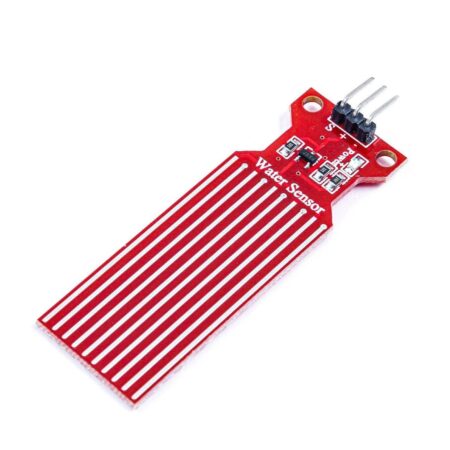
The Analog Water Level Sensor (Rain/Liquid Level Depth Sensor) is an easy-to-use, cost-effective electronic component designed to detect water presence, measure droplet density, and determine liquid level depth. It operates using resistive trace detection across ten exposed, interleaved copper traces on the sensor PCB.
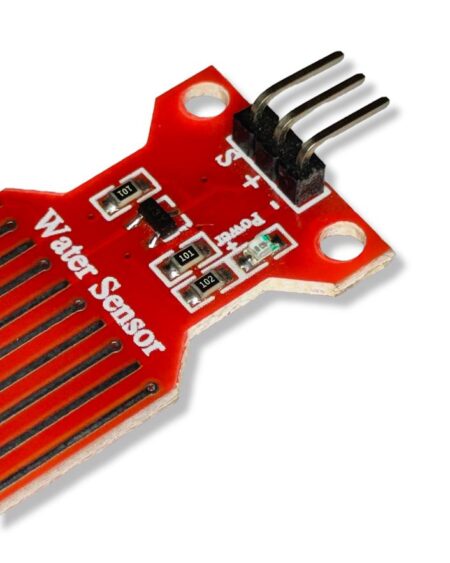
When submerged or exposed to water droplets, the conductive nature of water bridges the gap between adjacent interleaved traces, acting as a variable resistor. The level of water directly affects the overall electrical resistance: a higher water depth or greater surface immersion results in lower resistance and a higher output voltage at the signal pin (S). An onboard S8050 NPN transistor acts as an amplification/buffering driver, providing a smooth analog voltage signal suitable for microcontrollers like Arduino, ESP32, and Raspberry Pi.
| Key Components Identified On Module:
• Interleaved Copper Traces: 10 parallel exposed traces (5 power, 5 signal) for conductive sensing. • S8050 NPN Transistor: Amplifies weak currents passing through water for reliable analog signal readings. • Power LED Indicator: Provides visual confirmation when power (VCC and GND) is supplied to the module. • 3-Pin Header Interface: S (Signal / Analog Output), + (VCC / Power 3.3V–5V), – (GND / Ground). |
Overview
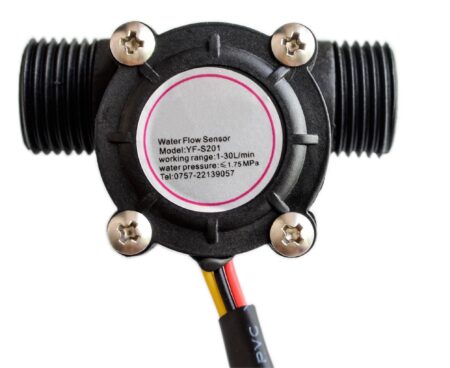
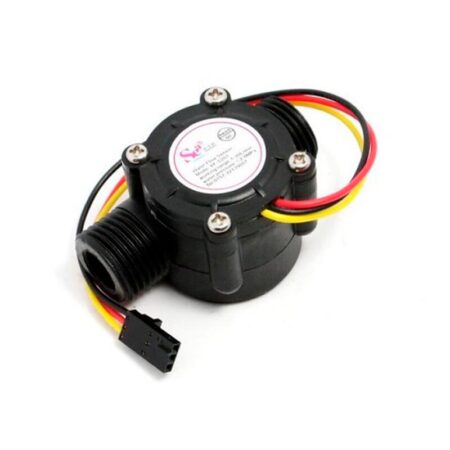
The YF-S201 is a widely used Hall-effect water flow sensor designed to measure liquid flow rate and volume in fluidics systems. It features a durable plastic body containing a water rotor (pinwheel) equipped with a magnetic element, alongside an integrated Hall-effect sensor module. When liquid flows through the sensor body, it forces the rotor to spin. As the internal magnets rotate past the Hall-effect sensor, magnetic pulses are generated. The output pulse frequency is directly proportional to the velocity and volume of the liquid passing through, allowing microcontrollers such as Arduino, ESP32, or Raspberry Pi to accurately measure flow rate and total volume.
Overview
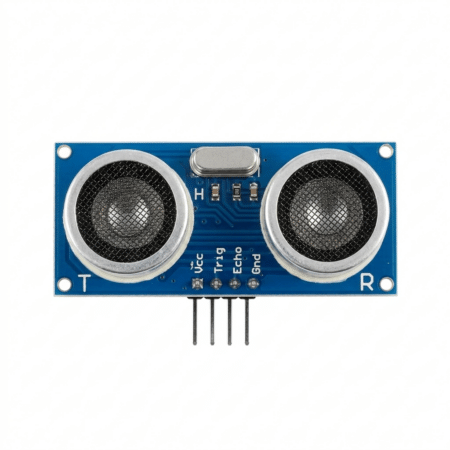
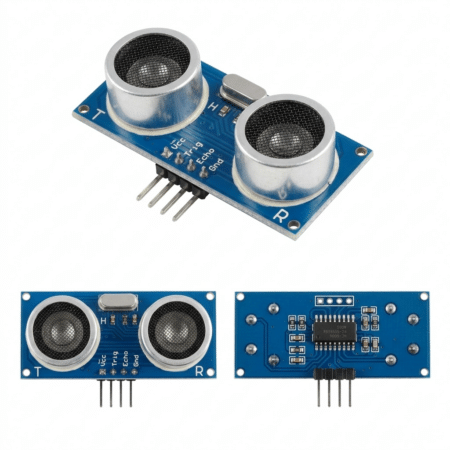
The HC-SR04 is a widely popular, low-cost ultrasonic distance sensor module designed for non-contact distance measurement. It operates on sonar principles, emitting ultrasonic sound bursts at 40 kHz and calculating the distance to an obstacle based on the time taken for the echo signal to return to the receiver.
As shown in the image, the module consists of an ultrasonic transmitter (labeled ‘T’) and receiver (labeled ‘R’), a 4-pin male header (Vcc, Trig, Echo, Gnd), a precision timing crystal, and onboard processing ICs on the back. It offers high accuracy (up to 3mm resolution) and stable readings ranging from 2 cm to 400 cm (~4 meters), making it an essential component for robotics, automation, and DIY microcontroller projects.
Overview
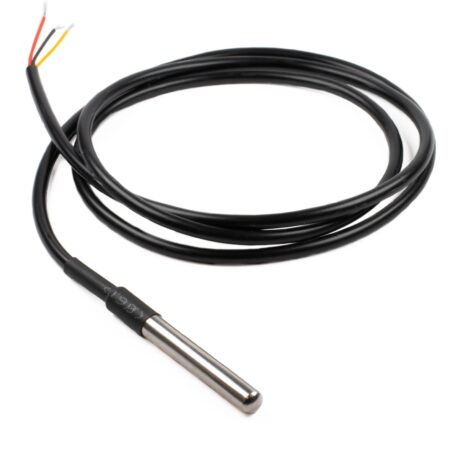
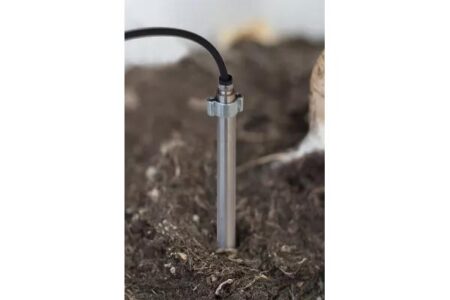
The DS18B20 Waterproof Soil Temperature Sensor is a highly accurate, digital temperature probe enclosed in a stainless steel casing. Designed specifically for harsh environmental conditions, it utilizes Maxim Integrated’s 1-Wire protocol, allowing precise digital temperature measurements over a single signal line. The rugged, waterproof stainless steel probe protects the internal thermal sensor against moisture, soil corrosion, and mechanical shock, making it an ideal component for automated agriculture, soil monitoring systems, and outdoor IoT applications.
From electronic components and embedded systems to robotics, drones, LED displays, EV solutions, and laboratory installations, LUMICA delivers reliable products and professional services for educational institutions, industries, startups, and technology enthusiasts.
Explore our complete range of innovative electronic products and services.
Explore our newest electronic devices, smart solutions, and innovative technology.
Overview
The Analog Water Level Sensor (Rain/Liquid Level Depth Sensor) is an easy-to-use, cost-effective electronic component designed to detect water presence, measure droplet density, and determine liquid level depth. It operates using resistive trace detection across ten exposed, interleaved copper traces on the sensor PCB.
When submerged or exposed to water droplets, the conductive nature of water bridges the gap between adjacent interleaved traces, acting as a variable resistor. The level of water directly affects the overall electrical resistance: a higher water depth or greater surface immersion results in lower resistance and a higher output voltage at the signal pin (S). An onboard S8050 NPN transistor acts as an amplification/buffering driver, providing a smooth analog voltage signal suitable for microcontrollers like Arduino, ESP32, and Raspberry Pi.
| Key Components Identified On Module:
• Interleaved Copper Traces: 10 parallel exposed traces (5 power, 5 signal) for conductive sensing. • S8050 NPN Transistor: Amplifies weak currents passing through water for reliable analog signal readings. • Power LED Indicator: Provides visual confirmation when power (VCC and GND) is supplied to the module. • 3-Pin Header Interface: S (Signal / Analog Output), + (VCC / Power 3.3V–5V), – (GND / Ground). |
Overview
The YF-S201 is a widely used Hall-effect water flow sensor designed to measure liquid flow rate and volume in fluidics systems. It features a durable plastic body containing a water rotor (pinwheel) equipped with a magnetic element, alongside an integrated Hall-effect sensor module. When liquid flows through the sensor body, it forces the rotor to spin. As the internal magnets rotate past the Hall-effect sensor, magnetic pulses are generated. The output pulse frequency is directly proportional to the velocity and volume of the liquid passing through, allowing microcontrollers such as Arduino, ESP32, or Raspberry Pi to accurately measure flow rate and total volume.
Overview
The HC-SR04 is a widely popular, low-cost ultrasonic distance sensor module designed for non-contact distance measurement. It operates on sonar principles, emitting ultrasonic sound bursts at 40 kHz and calculating the distance to an obstacle based on the time taken for the echo signal to return to the receiver.
As shown in the image, the module consists of an ultrasonic transmitter (labeled ‘T’) and receiver (labeled ‘R’), a 4-pin male header (Vcc, Trig, Echo, Gnd), a precision timing crystal, and onboard processing ICs on the back. It offers high accuracy (up to 3mm resolution) and stable readings ranging from 2 cm to 400 cm (~4 meters), making it an essential component for robotics, automation, and DIY microcontroller projects.
Overview
The DS18B20 Waterproof Soil Temperature Sensor is a highly accurate, digital temperature probe enclosed in a stainless steel casing. Designed specifically for harsh environmental conditions, it utilizes Maxim Integrated’s 1-Wire protocol, allowing precise digital temperature measurements over a single signal line. The rugged, waterproof stainless steel probe protects the internal thermal sensor against moisture, soil corrosion, and mechanical shock, making it an ideal component for automated agriculture, soil monitoring systems, and outdoor IoT applications.
Explore the latest trends, insights, innovations, and expert tips in electronic devices, smart technology, IoT, and more.



Login